Home › The three ATM fees
One cash withdrawal abroad can be hit with three separate fees How overseas ATM fees add up, and how to cut them
Push your card into a machine abroad to pull out some cash, and money can leak from three holes at once: your issuer's overseas-withdrawal fee, the flat operator fee on the machine you're standing at, and the DCC conversion the screen tempts you into. Stack all three and the share skimmed off a couple of hundred in cash can be absurdly high. The fix is really just two things, withdraw fewer times, and skip DCC every time, plus picking the right machine. Below, the three fees pulled apart one by one, and how to arrange your trips and which button to press.
On this page
- Who charges each of the three fees
- How much should you pull out at once?
- Which machine: bank-owned vs. mall / convenience-store unit
- When the screen asks about conversion, which button
- Which cards waive or refund the withdrawal fee
- Get the three numbers that belong to your card
- One illustrative worked example
- Five minutes when you get home, and you'll know what it cost
- The habits that cost the most
- When not to withdraw, and cancel instead
- Common questions
- What to read next
01Who charges each of the three fees
Treating the "overseas withdrawal fee" as a single number is where most people start overpaying. It's actually three separate charges from different sources, collected by different parties, each cut a different way.
| This fee | Who charges it | How it's roughly worked out | How to cut it |
|---|---|---|---|
| Overseas withdrawal fee | Your card issuer / bank | A flat fee per withdrawal, or a percentage of the amount, often with a minimum | Withdraw fewer times · pick a fee-free card |
| Machine operator fee | The operator of the ATM in front of you | A flat amount per withdrawal, largely independent of how much you take | Use bank-owned machines · take enough in one go |
| DCC conversion rate | The machine / acquirer (you tap agree) | A hard-coded, ugly rate with the margin baked in | Pick "without conversion · local currency" |
Once that table clicks, you see why "withdrawing in dribs and drabs loses the most": in the first two, the issuer's flat fee and the machine's flat fee are both charged per withdrawal, largely regardless of the amount. Withdraw once or five times, and the flat fees multiply five-fold, while the cash you need might have been covered in a single trip. The third, DCC, has nothing to do with frequency and everything to do with pressing the wrong button, and it's entirely dodgeable.
02How much should you pull out at once?
Since the flat fees are charged per withdrawal, the instinct is "take enough at once, don't keep going back". But there's a counterweight: take too much and the other two costs, cash safety and the loss on changing back what you don't spend, start to bite. So it's not "more is better", it's finding a balance.
A plain order of judgement:
- First estimate roughly how much cash this trip needs (by whether the destination is a cash society, how many nights, and whether there are cash-only situations).
- Compress it into as few withdrawals as possible: if one trip does it, don't split into three, that saves the most in flat fees.
- But don't take so much in one go that it's "painful to lose, a fat wad you can't spend". Better two medium withdrawals than one big lump on you.
- And don't withdraw one more just to round up before you leave; changing leftover foreign cash back is another loss.
In one line: let the flat fees push you to withdraw fewer times, and let safety and the leftover risk stop you taking too much at once.
03Which machine: bank-owned vs. mall / convenience-store unit
The same card, the same insert, and yet the machine's flat fee and DCC tricks vary a lot from one machine to the next.
Prefer: an ATM owned by a bank branch
The machines outside big banks or inside their halls usually run a more transparent, lower operator fee, their DCC nudges are relatively well-behaved, and if something goes wrong there's a person right there. Withdrawing at a bank branch in daylight is the least stressful tier.
Watch out: standalone units in malls, airports, convenience stores and on the street
These machines (some brands make their living off tourists) often run a higher flat fee and push DCC at you almost by default, with flashier screen scripts. The one in the airport arrivals hall deserves special wariness: pricey, conveniently placed, and waiting exactly for the moment you step off a flight with no energy left. If you really must use one, watch both the flat fee and the DCC closely.
ATM operator fee the machine announces first (this is the flat fee, it'll ask you to accept or decline); then a possible accept conversion / Conversion Rate versus without conversion prompt (this is DCC, pick without conversion); after the cash dispenses, keep the receipt and later match it against the posted amount / Original Amount on your statement. Any high "conversion rate" you can't read or get a straight answer on, assume it's the pricier option.
04When the screen asks about conversion, which button
Partway through a withdrawal, the machine will nine times out of ten pop a currency multiple-choice, commonly two wordings: "accept conversion (in your home currency)" or "continue without conversion, in local currency", and some dress up "lock in your rate" in bright colours to draw your tap.
The rule is identical to paying by card: pick "without conversion / in local currency". When the machine offers you a home-currency amount and invites you to "lock it", that's DCC: it sets the rate, it collects the markup. Letting your issuer handle the exchange is almost always the better deal. Of the three fees, this is the one most worth dodging and the easiest to dodge. The full picture of it is in the DCC piece.
05Which cards waive or refund the withdrawal fee
The first fee, the "overseas withdrawal fee", can sometimes be cut out entirely, if you hold the right card. A few categories of card are friendlier on overseas withdrawals:
- Some travel / multi-currency cards don't charge their own withdrawal fee within a cap (though they can't do anything about the machine's flat fee).
- Certain banks' specific debit / credit products have a waiver or after-the-fact refund arrangement for overseas withdrawals.
- A few cards refund the flat fee charged by third-party machines, though often with a monthly limit or conditions.
Be practical here: the exact rules, caps and whether a card covers the region you're heading to all follow that issuer's live official page; this site endorses no specific numbers for any one card. Before you leave, spend ten minutes searching your card's official notes for "overseas withdrawal / ATM / cash fee" and read the caps and region limits, which beats learning it cold at the machine. The multi-currency travel card piece covers how to read the fine print on these cards.
06Get the three numbers that belong to your card
Everything above is the shape of the charge. What you actually need are the numbers on the card in your pocket, and two cards from the same bank can be charged quite differently. Ten minutes with the right document gets you the figures to drop into the worked example below.
The document is not the glossy product page in the banking app. It is the fee schedule, usually filed as “fees and charges”, “tariff of charges” or “rates and charges”, often a PDF linked from the footer or tucked inside the help centre. Once you have it open, three lines matter:
| The number you want | What the schedule tends to call it | Why this line matters |
|---|---|---|
| The flat cash fee | “non-sterling cash fee”, “cash withdrawal fee”, a fixed amount per withdrawal | It ignores how much you take, so it punishes small withdrawals hardest |
| The percentage fee | “X% of the amount withdrawn”, sometimes folded into a non-sterling transaction fee | It scales with the amount, and it is usually charged as well as the flat fee, not instead of it |
| The minimum and maximum | “minimum £X, maximum £Y”, tacked on the end of the line above | The line everyone skims past, and the one that decides what a small withdrawal really costs |
That third line deserves a moment. A card advertising “1.5% of the amount, minimum £3” is not charging you 1.5%. Withdraw the equivalent of £50 and 1.5% would be 75p, but the minimum makes it £3 — six percent, four times the headline. A minimum charge is the quiet tax on withdrawing little and often, and it is printed exactly where nobody reads.
One cost will not appear in that document at all: the card network's own conversion margin. It is never a fee line; it lives inside the rate you were given. So the schedule tells you the visible charges, and the invisible layer only surfaces when you reconcile afterwards.
If you genuinely cannot find the schedule, and some banks bury it well, don't guess. Ask on the phone or in chat, in three questions: what is the flat fee for a cash withdrawal abroad, what is the percentage, and is there a minimum. Write the answers down with the date, because tariffs get revised and yours will be out of date eventually.
Where do you get a mid-market figure to compare against? The European Central Bank publishes a set of euro reference rates every working day, listed openly on a single page.
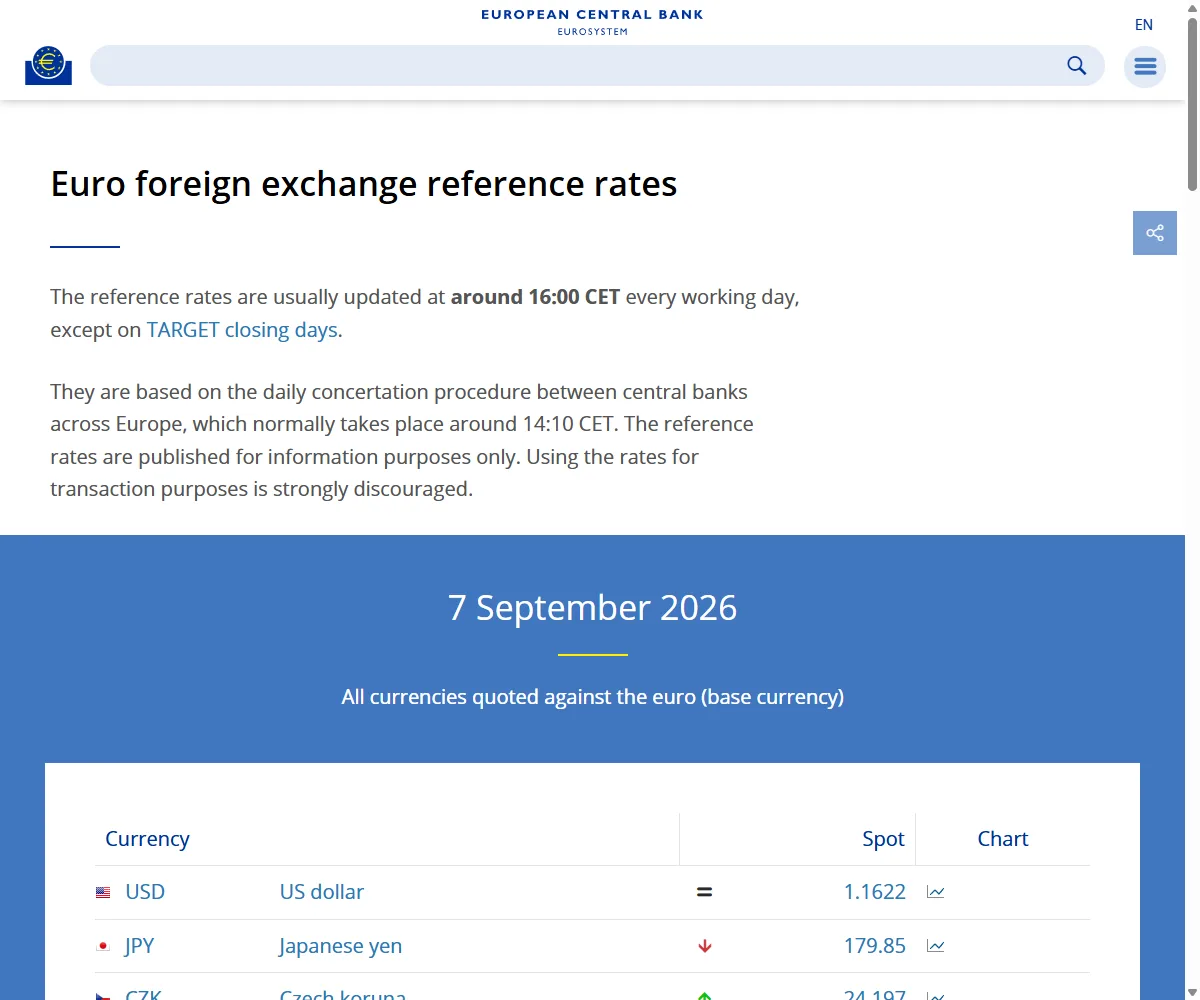
For a pair that doesn't involve the euro, divide one currency's euro rate by the other's and you have a serviceable reference. Chasing decimal places is beside the point here. You were never trying to find the “correct” rate; you were trying to see how big a slice went missing.
07One illustrative worked example
Let me show you the effect of frequency (numbers are purely illustrative, only to show the scale, not any quote). Say this trip you need the equivalent of about 3,000 units of local currency in cash:
| Approach | Withdrawals | Flat fees (per trip) | Flat fee total (illustrative) |
|---|---|---|---|
| All in one go | 1 time | 1 issuer + 1 machine | ≈ 1 unit |
| Split in two | 2 times | Each item ×2 | ≈ 2 units |
| Small daily withdrawals | 5 times | Each item ×5 | ≈ 5 units |
Same 3,000 covered, but spread across five withdrawals the flat fees alone multiply several-fold, and that's before the extra loss from being nudged into DCC each time. So the main lever for saving is always to push the number of withdrawals down, then add "pick local currency, use bank-owned machines". And, as said above, don't take so much in one go that losing it would hurt; keep it balanced.
08Five minutes when you get home, and you'll know what it cost
On the day the statement lands, most people glance at the total and move on. But the cost of cash abroad is spread across three places: a line on the ATM slip, a fee line on the statement, and a third that appears nowhere at all because it is buried in the rate you were given. Until all three sit on the same page, you don't know what that cash cost you.
You need three things: the ATM slip or a photo of the screen, the statement entry, and the mid-market rate for that date. Then three steps, in this order:
- Work out the rate you actually got. Divide the amount charged to your account by the local-currency amount you actually received. The denominator is the cash in your hand, not counting any surcharge the machine took separately.
- Measure the distance from mid-market. (your rate ÷ that day's mid-market rate − 1) × 100%. Whatever that percentage turns out to be, it holds the network margin, your issuer's percentage fee, and any DCC you accepted at the screen.
- Add the visible fees back on. Take the flat fee from the statement and the operator surcharge from the slip, express each as a percentage of what you withdrew, and add them to step two. That total is the real cost of getting that cash.
How to read the answer. A withdrawal that ran on the network alone, with the conversion prompt declined, sits a modest distance from mid-market. If your number comes out noticeably wider than that, the likeliest explanation is that you accepted the machine's own conversion, and that layer is usually the heaviest of the lot. When the figure surprises you, the first thing to recall is whether a screen ever asked you to pick a currency.
If reconciling turns up a charge you cannot account for, or the posted amount is a long way from your estimate, don't sit on it. Go to your issuer with the transaction date, the local-currency amount, and the reference number of that entry on the statement, and ask how it was converted. Your issuer can explain what it charged and at what rate it posted; it cannot explain a surcharge taken by the machine's operator, which is a different company entirely. Disputes generally have a time limit, so earlier is better — the exact window is in your card terms.
09The habits that cost the most
- Withdrawing on reflex at the airport ATM right after you land, pricey and DCC by default, one of the worst places to withdraw.
- Afraid of carrying too much, taking a little every day: flat fees are per withdrawal, so the more spread out, the more you lose.
- The machine asks about conversion and, to "see numbers I understand", you tap "accept conversion", gifting away a DCC layer.
- Forcing a withdrawal on a card whose withdrawal rules you've never read, when its own fee might have been waivable.
- Withdrawing one more to round up before you leave, ending with a handful of change you can't change back.
10When not to withdraw, and cancel instead
- The screen forces a choice with a high "conversion rate" you can't read, pick without conversion, or just cancel and find a bank-owned machine.
- The machine's flat fee it announces is absurdly high, cancel and walk a few steps to a bank-branch machine.
- The card slot is loose, there's a suspicious little device stuck on, or the keypad feels off, don't withdraw, switch machines: this is about skimming risk.
- You can actually tap your card just fine here and don't really need cash, then don't withdraw, tap when you can.
11Common questions
Is withdrawing really pricier than tapping a card?
In most cases a withdrawal carries the three fees, so it isn't cheap overall. Where you can tap a card (and pick local currency), tap; save cash for the places that only take cash. See cash or card abroad.
Is the machine's flat fee charged by my bank?
No. The machine's flat fee is collected by the operator of the ATM in front of you, a separate charge from your issuer's overseas-withdrawal fee. Pick a bank-owned machine and this one is usually lower.
Do I pick local currency when withdrawing too?
Yes. "Accept conversion / lock rate" on the ATM is DCC; pick "without conversion, in local currency" and let your issuer do the exchange, which is the better deal.
Is there a way to skip the withdrawal fee entirely?
Some cards waive the issuer's fee, and a few even refund the machine's flat fee, but caps, regions and limits all differ. Follow that issuer's live official page; this site quotes no specific numbers.
12What to read next
Update note: first published 2026-06-19; two sections added 2026-09-08, on finding your own card's numbers and on reconciling a withdrawal afterwards, with a real screenshot of the ECB reference rates page. The fee units and proportions in this piece are illustrative to aid understanding; the actual withdrawal fee, machine flat fee and exchange rate follow each bank, card issuer and ATM operator's live official page and your statement.
Sources: publicly published issuer overseas-withdrawal-fee notes, the reference rates and dynamic-currency-conversion disclosure rules published by Visa / Mastercard, and the author's years of cross-border withdrawal receipts and reconciliation records.
Official references:Visa exchange-rate calculator;Visa travel guidance;Mastercard rate and support tools;Mastercard foreign-currency FAQ;ECB reference rates;CFPB foreign-fee disclosure rule。