Home › Deposit holds abroad
The money that vanished from your card at check-in: how deposit holds work abroad Hotels, car hire desks and fuel pumps, and how to get the money back sooner
You check in, hand over a card for the room, and that evening your banking app shows a balance a few hundred pounds lower than you expected. Nothing has actually been charged. The hotel has reserved the money, and until it lets go you can't spend it. A car hire desk does the same thing, usually for a much bigger sum, and a pay-at-pump fuel station does it for a round figure that has nothing to do with how much fuel you put in. This guide covers what those holds are, how long each kind tends to last, the one situation where they genuinely cost you money, and what to say at the desk and at check-out so the money comes back sooner.
Contents
- A hold reserves your money, it doesn't take it
- Hotels, car hire desks and fuel pumps: what each one is guarding against
- How long does a hold stay on? Anywhere from a week to about a month
- Why does the money sometimes look like it left twice?
- A hold that lapses costs nothing; a deposit charged and refunded costs twice
- Credit card or debit card for the deposit?
- Four questions to ask before you hand the card over
- Checked out, car returned, money still missing
- Common questions
- Read next
01A hold reserves your money, it doesn't take it
Every card payment happens in two steps. First the shop asks your bank whether the money is there, and the bank sets that amount aside. Later the shop collects it, and the payment settles. For a coffee the gap between the two is a few seconds to a few days and you never notice it. A hold stretches that gap on purpose. The hotel asks your bank to set aside an estimate, the room plus a margin for anything you might add, and only collects the real figure when you leave. The car hire firm sets aside enough to cover the insurance excess. The fuel pump sets aside a fixed sum before it has any idea how much you'll pump.
What that reservation does to you depends on the card. On a debit card it comes out of your available balance: on paper the money is still yours, but you can't spend it. On a credit card it comes off your available credit instead, so your cash is untouched and your limit shrinks for a while. Most of the practical advice further down follows from that one difference.
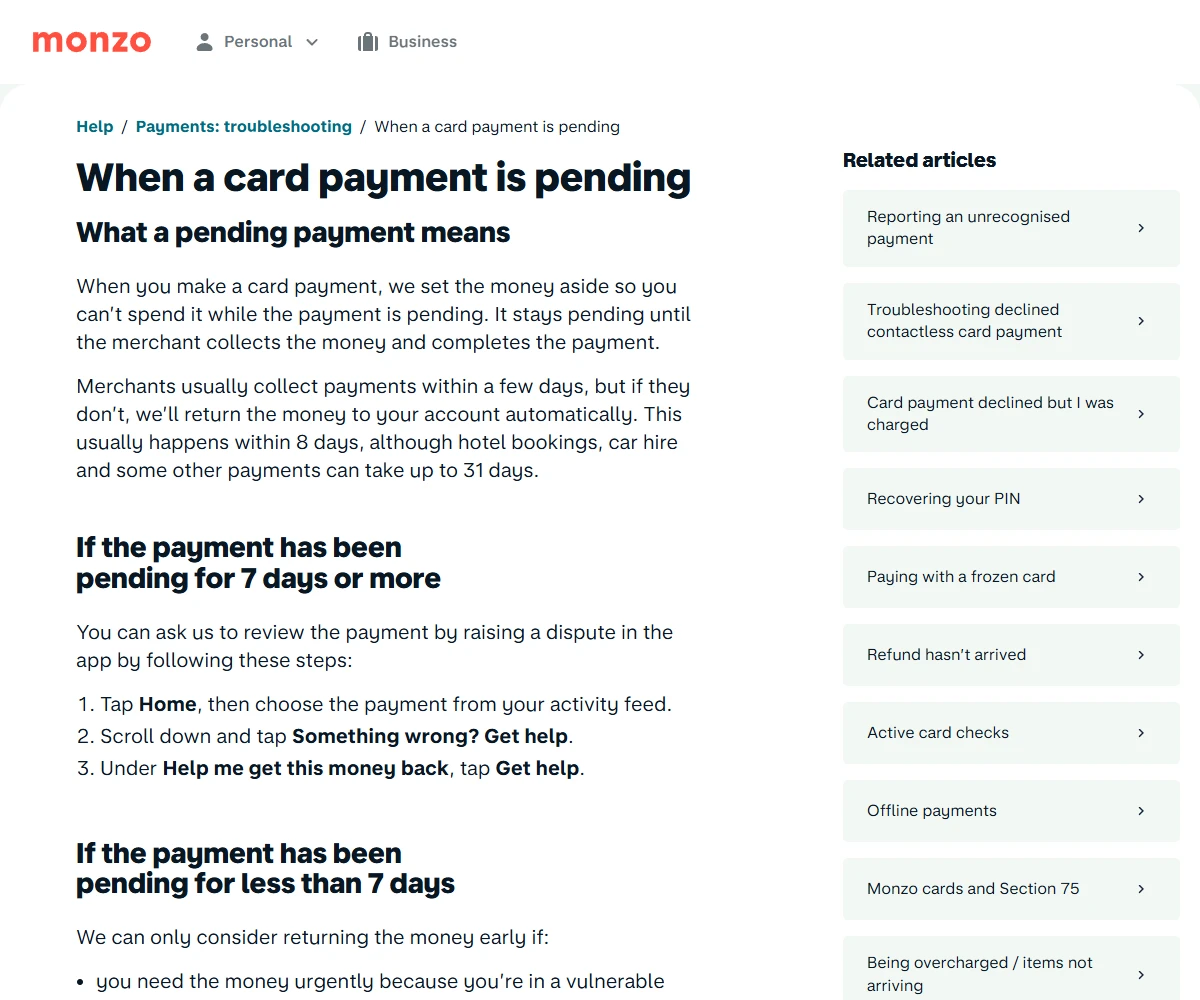
In your banking app a hold normally shows up as a pending payment. Monzo's help page puts it plainly: the money is set aside so you can't spend it while the payment is pending, and it stays that way until the merchant collects it.
02Hotels, car hire desks and fuel pumps: what each one is guarding against
The amount of a hold is decided by the merchant, and it's sized to whatever that merchant is afraid of losing. That's why the same card can see a modest hold at a guesthouse and a very large one at an airport car hire counter on the same trip.
| Where | What the hold covers | What you'll usually see | Worth knowing |
|---|---|---|---|
| Hotel or apartment | The room, plus extras such as the minibar, room service or damage | One hold at check-in, sometimes topped up on a longer stay | If the room was prepaid, the hold at the desk is only for extras and is often smaller |
| Car hire desk | The insurance excess, plus fuel, tolls or fines billed after you return | Often the largest hold of the whole trip | Buying the desk's own excess cover often shrinks it; a separate excess policy bought at home usually doesn't |
| Pay-at-pump fuel | A fill-up of unknown size | A fixed round amount, then corrected to what you actually pumped | Paying inside at the kiosk avoids the pre-set amount entirely |
| Bike, ski or equipment hire, some tours | Damage, or the item not coming back | Anything from a small hold to a real charge | Ask whether it's a hold or a payment; the answer changes which card you should use |
The one column people forget is the last. A separate excess policy bought before the trip protects you if something happens to the car, but the hire company still wants its own guarantee, so the full excess normally gets held on your card anyway. Plan the card's limit around that figure, not around the rental price.
03How long does a hold stay on? Anywhere from a week to about a month
When the merchant takes the final amount properly, the hold is replaced by the real charge and the rest of the reserved money comes back, often within a few days. The long waits happen when the merchant never completes it and your bank has to let it lapse on its own schedule. That schedule belongs to the bank, and it isn't the same everywhere.
Two UK examples show the range. Monzo says it usually returns an uncollected payment within 8 days, but that hotel bookings, car hire and some other payments can take up to 31 days. Wise says most reserved money is released within 7 days, and within 30 days for pre-authorisations such as hotels and car rental.
Hotels and car hire get the longer window because their final bill genuinely isn't known until you leave, and a stay or a rental can run for weeks. The practical upshot is that the same car hire hold can vanish from one card in four days and sit on another for three weeks without either bank doing anything wrong. The number that applies to you is on your own bank's help pages; searching them for "pending" or "pre-authorisation" usually finds it in a minute.
04Why does the money sometimes look like it left twice?
This is the one that sends people to the phone. You check out, the hotel takes the final bill, and now the app shows two lines from the same hotel: the final charge and the original hold. There are two ordinary reasons for it.
The first is timing. The final charge lands before your bank has matched it to the hold, and for a day or two both are visible. That usually sorts itself out. The second is how the merchant ran the final bill. If the desk puts it through as a brand-new sale instead of completing the original authorisation, your bank has nothing that links the two, so the hold stays put until it lapses. You haven't paid twice, one of those lines will never settle, but until it drops off it's money you can't touch.
Telling the two apart is simple. A hold stays marked as pending; a real charge settles and moves to completed. Two completed payments to the same hotel for the same stay is a genuine double charge, and that calls for a refund request and, if needed, a dispute with your card issuer rather than waiting.
A large hold can also be the hidden reason a card starts getting declined halfway through a trip. On a debit card with a car hire deposit sitting on it, the next restaurant bill may simply be more than what's left available. If that happens, the steps in what to do when a card stops working abroad apply, and the fix is usually a different card rather than a phone call.
05A hold that lapses costs nothing; a deposit charged and refunded costs twice
A euro hold on a sterling card is converted only so the app can show you a pending figure. If the hold lapses, nothing ever converts and nothing is lost. The expensive case is different: the merchant takes the deposit as a real payment at pick-up and refunds it after you return. Smaller car hire firms, private apartment rentals and some independent hotels do this. Now the money crosses the currency line twice, on two different days, and any fee your card charges on non-sterling payments may apply on the way out and not come back.
| Illustrative: a €1,000 deposit taken at pick-up, refunded ten days later | Amount |
|---|---|
| Charged at pick-up, €1,000 at 0.870 | £870.00 |
| Non-sterling transaction fee at 2.99% | £26.01 |
| Total leaving your account | £896.01 |
| Refunded ten days later, €1,000 at 0.855 | £855.00 |
| What the deposit you "got back" cost you (assuming the fee isn't returned) | £41.01 |
The rates and the fee in that table are there to show the mechanism, not to predict your bill: the rate could just as easily move in your favour, and some cards charge no foreign fee at all. What doesn't change is that a charged-and-refunded deposit exposes you to two conversions, while a hold exposes you to none.
The desk can make it worse. If the terminal offers to take the deposit in pounds, that's dynamic currency conversion, and a deposit converted at the terminal's marked-up rate may be refunded at a different one; the DCC guide explains why local currency is the right answer every time. And if you're not sure what your own card charges on foreign payments, here's where to find it on a statement.
06Credit card or debit card for the deposit?
For anything large, a credit card is usually the better tool, and car hire desks often decide it for you: many want a credit card in the main driver's name for the deposit and won't take a debit card for it, even when the rental itself was prepaid. That rule lives in the rental terms, so read your voucher before you fly rather than discovering it at the counter with a queue behind you.
There's a reason to prefer credit even where debit is allowed. On a debit card a £1,000 hold is £1,000 of your holiday money frozen, possibly for weeks after you're home. On a credit card it's £1,000 of limit. Just check the limit covers the hold and everything else you plan to spend, because a hold that eats most of a limit produces declines later in the trip.
If debit is all you have, treat the hold as money you won't see until a few weeks after you get back, and keep a second card for day-to-day spending so the deposit card can simply sit there.
I've put a car hire deposit on a debit card exactly once, and only because the credit card was in a drawer at home. The rental was prepaid, the desk took the excess as a hold, and I thought no more about it. The final fuel charge went through as a separate sale a few days after I returned the car, so the original hold had nothing to attach to and simply sat there. It came back more than three weeks later, long after the trip, and for that whole stretch the account looked a good deal emptier than it was. Nothing was lost in the end. It was just a month of doing sums around money that wasn't really gone.
07Four questions to ask before you hand the card over
A minute of questions at check-in or at the car hire counter saves most of the trouble described above. The answers are also exactly what your bank will ask you for if a hold overstays.
- How much are you holding, and in which currency? The answer should be the local currency.
- Is this a hold, or are you taking the payment now?
- When I check out or bring the car back, will the final bill complete this hold, or go through as a separate payment?
- Once I've left, when will you release whatever is left of the hold?
Photograph the paperwork or keep the email that states the amount. At a fuel pump none of this applies, and if you'd rather not have a fixed sum blocked at all, pay inside at the kiosk.
08Checked out, car returned, money still missing
On the day you leave, three things help. Ask the desk to release the pre-authorisation and to give you a receipt or an email that says so. Pay the final bill on the same card that carries the hold, so the bill completes it instead of sitting next to it. And if you pay the final bill some other way, in cash or on another card, say so out loud and ask them to release the hold on the first card, because otherwise nobody will.
After that, give it the window your bank publishes. If it's still there once that has passed, contact the merchant with your booking reference and ask for the authorisation to be reversed, then contact your bank with whatever the merchant sent you. Banks can sometimes act sooner: Monzo, for example, lets you ask for a review once a payment has been pending for 7 days, and will consider returning it earlier than that if you can show the merchant won't collect it, such as a hotel confirming it released a deposit because you paid another way.
If the line has moved from pending to completed, it was never a hold. That's a real payment, and the route is a refund request to the merchant first and a dispute with your card issuer if that goes nowhere.
09Common questions
Why does my available balance show less than I actually spent at the hotel?
Because the hotel placed a hold at check-in for the room plus a margin for extras. The money is set aside rather than taken, so it drops out of your available balance until the hotel collects the final bill or the hold lapses on your bank's schedule.
How long does a car hire deposit take to come back?
If the company closes the rental properly, the unused part of the hold often drops off within a few working days. If it never completes the hold, it lapses on your bank's schedule, which for car hire can be up to about a month on some UK cards. Your bank's help pages give the exact window.
Can I use a debit card for a car hire deposit?
Sometimes, but many car hire desks require a credit card in the main driver's name for the deposit, even when the rental was prepaid. The rule is in the rental terms, so check your voucher before you travel.
Do I lose money on the exchange rate when a deposit is released?
Not if it was only a hold that lapsed, because nothing was ever converted. You can lose money when a deposit was charged as a real payment and refunded later, since it is converted twice on two different days and a foreign transaction fee may not be returned.
The hotel charge shows twice in my app. Have I paid twice?
Usually not. One line is normally the original hold, still pending, and the other is the final bill. If both have moved to completed for the same stay, that is a genuine double charge and worth raising with the hotel and then your card issuer.
10Read next
Update note: First published 2026-09-25. Hold amounts are set by each merchant and release times by each card issuer; the Monzo and Wise figures quoted are from their public help pages as read on 2026-09-25 and apply to those cards only. The deposit table is illustrative, not a forecast of any rate or fee.
Sources: Monzo Help: when a card payment is pending · Wise Help Centre: my Wise card transaction is still pending, and the author's own records of hotel, car hire and fuel holds across many trips.