Home › Paying in China with a foreign card
How to pay in China as a foreigner: using Alipay and WeChat Pay with a foreign card No Chinese phone number needed, no fee under ¥200, and what to do when the app won't take your card
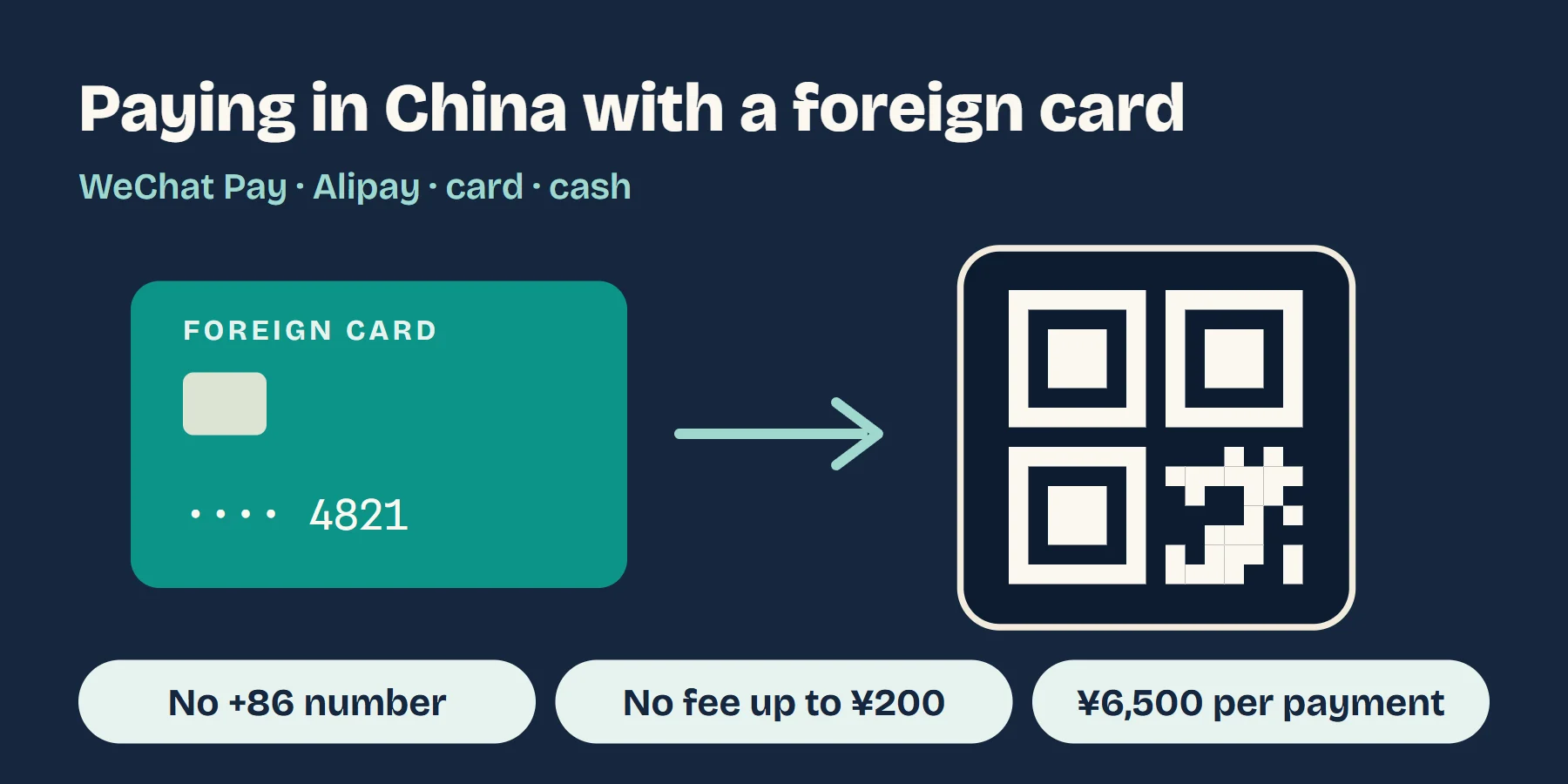
In mainland China most convenience stores, noodle shops and taxis show you a QR code and expect you to scan it. If all you have is a Visa or Mastercard issued at home, the simplest fix is to link that card to WeChat Pay or Alipay and scan like everyone else. On WeChat Pay it takes three steps: update the app, add your card under Me › Pay and Services › Wallet, and enter your passport details when asked. You don't need a Chinese phone number. A single payment of ¥200 or less carries no fee, anything above that costs 3%, and one payment can't go over ¥6,500. This guide walks through that route first, then covers what to do when the card won't link or a payment bounces, so you still get through the day with a card or cash.
Contents
- Three ways to pay in mainland China: QR code, card, cash
- How to add a foreign card to WeChat Pay: three steps, no +86 number
- WeChat Pay foreign card fees and limits: free up to ¥200, 3% above
- Alipay with a foreign card, and paying with a wallet from home
- No app, or it won't scan: pay by card or withdraw cash
- Card won't link or a payment is rejected: check in this order
- Ten minutes of setup before you fly
- Common questions
- Read next
01Three ways to pay in mainland China: QR code, card, cash
It helps to see the three side by side. Small everyday spending is mostly QR codes, bigger bills and hotels can go on a card, and cash is the fallback. Have all three ready and you won't get stuck at a till.
| Method | Where it works | What you need | Watch out for |
|---|---|---|---|
| Foreign card linked to WeChat Pay or Alipay, scan to pay | Anywhere with a QR code: convenience stores, small restaurants, taxis, kiosks at sights | A phone number that gets SMS, your passport, a card from home, mobile data | No red packets or transfers on a foreign card; WeChat Pay charges 3% on single payments above ¥200 |
| Pay with the card itself | Hotels of three stars and above, 4A and 5A scenic sites and similar | A card carrying a Visa, Mastercard or other network logo | Many small shops have no card terminal; if asked which currency, choose yuan |
| Cash | Street stalls, a failed scan, a flat phone battery | Exchange at a bank branch or withdraw at an ATM | Your card issuer charges for withdrawals, and the local machine may too |
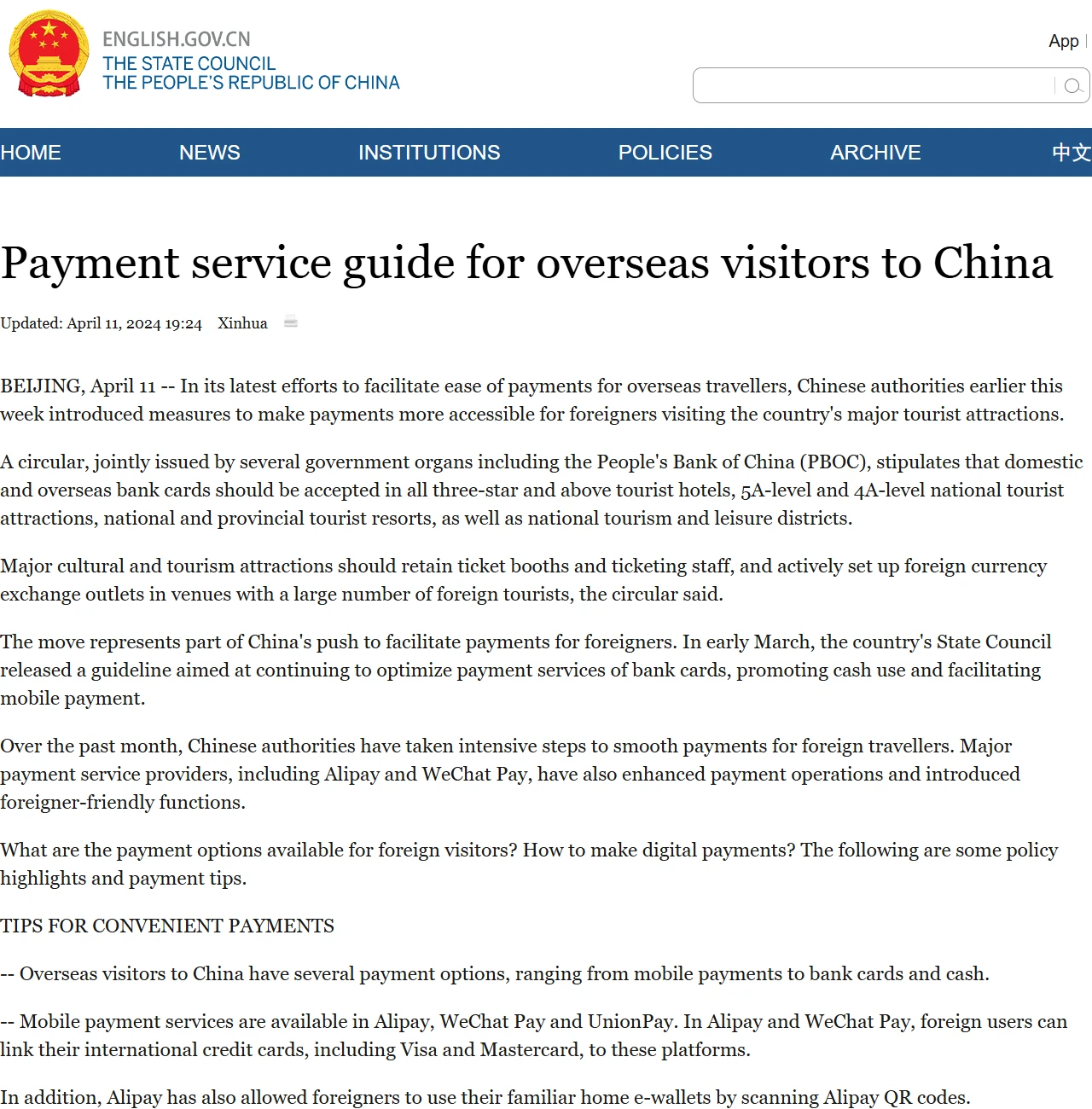
All three routes are set out in the "Payment service guide for overseas visitors to China" published on the Chinese government's English-language site in April 2024. It says Alipay and WeChat Pay accept foreign cards such as Visa and Mastercard; that key hotels and scenic sites must accept domestic and foreign bank cards, with staffed ticket windows kept open at sites; and that cash can be exchanged at bank branches showing a currency exchange sign or withdrawn in yuan from ATMs that carry your card network's logo.
02How to add a foreign card to WeChat Pay: three steps, no +86 number
WeChat's help centre lists three steps for international cards:
- Download or update WeChat to the latest version and register or sign in with your own phone number. It doesn't have to be Chinese, as long as it can receive SMS codes.
- Tap Me › Pay and Services › Wallet.
- In Wallet, tap Bank Cards › Add a Bank Card, read and agree to the Weixin Pay user agreement and privacy policy, then follow the screens to enter your identity details and card number. If you verify with a passport, you'll get a notification asking you to upload a copy of it.
The documents it accepts are a passport, a Chinese foreign permanent resident ID card, or a mainland travel permit or residence permit for Hong Kong, Macau and Taiwan residents.
Once the card is in, paying is one of two moves: scan the shop's QR code and type the amount, or open your own payment code and let the cashier scan it. The one limit worth remembering is that foreign cards are for everyday purchases in mainland China only. Red packets and money transfers aren't supported, so if friends want to split dinner by "just send it to me", you'll need cash, or let one of them pay and hand over your share.
03WeChat Pay foreign card fees and limits: free up to ¥200, 3% above
| Item | What WeChat's help centre says for international cards |
|---|---|
| Fee | None on a single payment up to ¥200; 3% on a single payment above ¥200; the payment page shows the fee |
| Fee on a refund | Refunded in proportion to the amount refunded |
| Per payment | ¥6,500 |
| Per month | ¥50,000 in total |
| Per year | ¥65,000 in total |
| Exchange rate | Set by your card network and the bank that issued your card |
On a normal trip that means breakfast, metro rides, taxis and snacks, the payments under ¥200, cost nothing extra to scan. A dinner for a few hundred yuan, a hotel night or a train ticket costs 3% more through the app. If your card's own foreign transaction fee is below 3%, paying those bigger bills with the card directly usually works out cheaper, provided the place takes cards.
Keep two charges apart in your head. WeChat Pay's 3% is charged on its side; when your bank converts the yuan into your home currency, it may also apply its own foreign transaction fee under your card's terms, and this guide shows where to find that on a statement. And the exchange rate comes from your card network and issuer, not from WeChat, so the same purchase can land on two cards as slightly different amounts.
One 2026 change is worth knowing about. On 27 May 2026 Tencent announced that WeChat users linking an international card for the first time get 90 consecutive calendar days without the international card fee, counted from their first transaction, with the waiver capped at ¥1,000 of spending a day. The announcement doesn't give start or end dates for the offer; if the payment page shows a fee of zero, it's applying to you. Because the 90 days start with your first payment, linking the card at home before you leave doesn't use any of them up.
04Alipay with a foreign card, and paying with a wallet from home
Alipay also takes Visa, Mastercard and other foreign cards, and the process looks much like WeChat's: install Alipay, register with your own phone number, add a card in the app and complete the identity check it asks for. We couldn't find a public page from Alipay setting out its fee on foreign cards at the time of writing, so look at the final amount on the confirmation screen before you approve each payment.
On limits, the 2024 government guide says the cap for overseas visitors on payment platforms was raised from US$1,000 to US$5,000 per transaction and from US$10,000 to US$50,000 a year. That's the overall ceiling set for the platforms; WeChat Pay also has its own yuan limits for foreign cards, listed above, and those are the ones you'll run into day to day.
If you already use an e-wallet at home, you might not need to link a card at all. The same 2024 guide says Alipay lets some overseas e-wallets scan its codes directly, naming TrueMoney from Thailand and Changi Pay from Singapore as examples. Tencent's May 2026 announcement says PayPal wallets can scan to pay at WeChat Pay merchants, initially for PayPal users in the US. Before you go, check your own wallet app for a mention of paying in mainland China.
05No app, or it won't scan: pay by card or withdraw cash
Some people would rather not hand a card to a new app, and some find on arrival that the passport upload is stuck or there's no signal. There are two other ways through the day.
Pay with the card. The 2024 guide requires hotels of three stars and above, 4A and 5A scenic sites and similar places to accept domestic and foreign bank cards, and scenic sites to keep staffed ticket windows. At a hotel desk, a ticket office or a larger shopping centre, just ask whether they take Visa. If the terminal or the cashier asks which currency to charge, choose yuan, not your home currency; the home-currency option is DCC, and its rate is worse.
Get cash. The guide gives two ways: exchange money at a bank branch with a currency exchange sign, or withdraw yuan from an ATM carrying your card network's logo, such as Visa or Mastercard. Most of the cost of a withdrawal comes from your own bank, and the ATM fees guide breaks down who charges what. Cash is still accepted, but small shops may be short of change, so break big notes at a hotel or a larger shop first.
For how much cash to carry, the day-by-day method in cash or card abroad works for China too: if scanning is your main way to pay, a day or two of small spending in cash is enough.
06Card won't link or a payment is rejected: check in this order
When a scan won't go through, it's usually one of the following. Working down the list normally finds the cause in a few minutes.
- Read the message first. If it says your identity details don't match, check the spelling of your name, your date of birth and your passport number as entered. A card in a name that doesn't match your passport may also fail to link; use a card in your own name.
- No clear message, just a failure: check your bank. Open your banking app or texts and look for a "confirm this transaction" alert. Card issuers can block the first payment from China until you confirm it's you. Confirm, then try again; if there's no alert, call the number on the back of the card. This guide goes through each kind of decline abroad.
- Over the limit. A foreign card on WeChat Pay tops out at ¥6,500 per payment, and payments also stop once you hit the monthly or yearly total. Put big bills on the card directly.
- It's a transfer, not a purchase. If someone asks you to "send it to me" instead of scanning a shop's payment code, a foreign card won't work. Pay cash.
- Try another card. If Visa fails, try Mastercard, or a card from a different bank. That's why it pays to carry cards on two networks.
If none of that works, settle this payment with a card or cash and sort the app out later on a decent connection. Retrying the same card over and over at the till adds failed attempts, and a run of those makes it more likely your bank freezes the card for a while.
07Ten minutes of setup before you fly
- At home, install WeChat or Alipay, register, add your card and upload your passport. Verification can take a while, so don't leave it for the arrivals hall.
- Turn on transaction alerts in your banking app and make sure the card is enabled for use abroad.
- Carry two cards on different networks, and keep them in different places.
- Sort out mobile data or roaming. Scanning needs a connection, and hunting for Wi-Fi at the till rarely works.
- Decide where your first cash comes from: a little exchanged before you leave, or an ATM with your card network's logo at the airport.
For the rest of the travel wallet, see the full pre-trip money checklist.
08Common questions
Do I need a Chinese phone number to use WeChat Pay as a foreigner?
No. WeChat's help centre says an international number works as long as it can receive SMS codes. You verify your identity with a passport, a Chinese foreign permanent resident ID card, or a mainland travel permit or residence permit for Hong Kong, Macau and Taiwan residents.
How much does WeChat Pay charge on a foreign card?
Nothing on a single payment of ¥200 or less, and 3% on a single payment above ¥200. If you get a refund, the fee is refunded in proportion. In May 2026 Tencent announced that people linking a foreign card for the first time pay no fee for 90 days from their first payment, on up to ¥1,000 a day. Your own card issuer may add its foreign transaction fee on top.
What is the WeChat Pay limit for a foreign card?
¥6,500 per payment, ¥50,000 a month and ¥65,000 a year. For anything bigger, such as a hotel bill, pay by card at the desk.
Can I send red packets or transfer money with a foreign card on WeChat?
No. Foreign cards work for everyday purchases in mainland China only; red packets and transfers are not supported. To split a bill with friends, pay your share in cash or let someone else pay and settle up in cash.
Can I just use my Visa or Mastercard in China without Alipay or WeChat Pay?
In some places. The government's 2024 payment guide says hotels of three stars and above, 4A and 5A scenic sites and similar places must accept domestic and foreign bank cards, but small shops and street stalls mostly take QR payments or cash. If the terminal asks which currency to charge in, choose yuan.
09Read next
Update note: First published 2026-10-06. The WeChat Pay steps, accepted documents, limits and fees come from WeChat's help centre guide to international cards; the 90-day fee waiver and PayPal scanning come from Tencent's announcement of 27 May 2026; card acceptance, cash, the 2024 limit increase and overseas e-wallets on Alipay come from the payment guide on the Chinese government's English-language site, 11 April 2024. All were read on 2026-10-06.
Sources: WeChat Help Center: Guide to Add and Use International Cards with Weixin Pay · Tencent, 27 May 2026: three initiatives to make inbound payments easier · english.www.gov.cn: Payment service guide for overseas visitors to China.