Home › Fees on your statement
What is the international service fee on my bank statement? A line-by-line guide to foreign card charges after a trip Check each line against a receipt first; fees in your card agreement rarely come back, but wrong amounts, double charges and missing refunds can be disputed
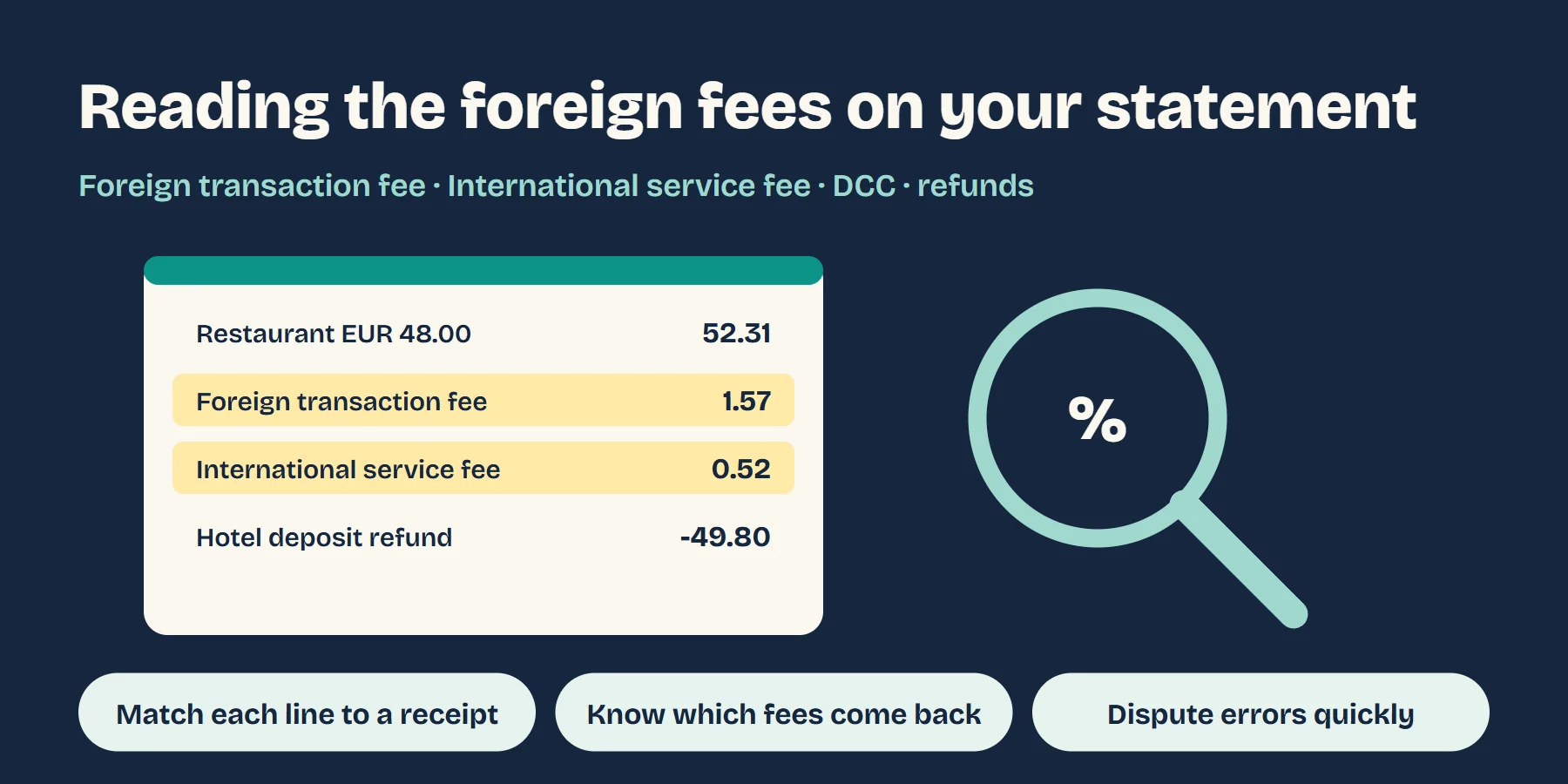
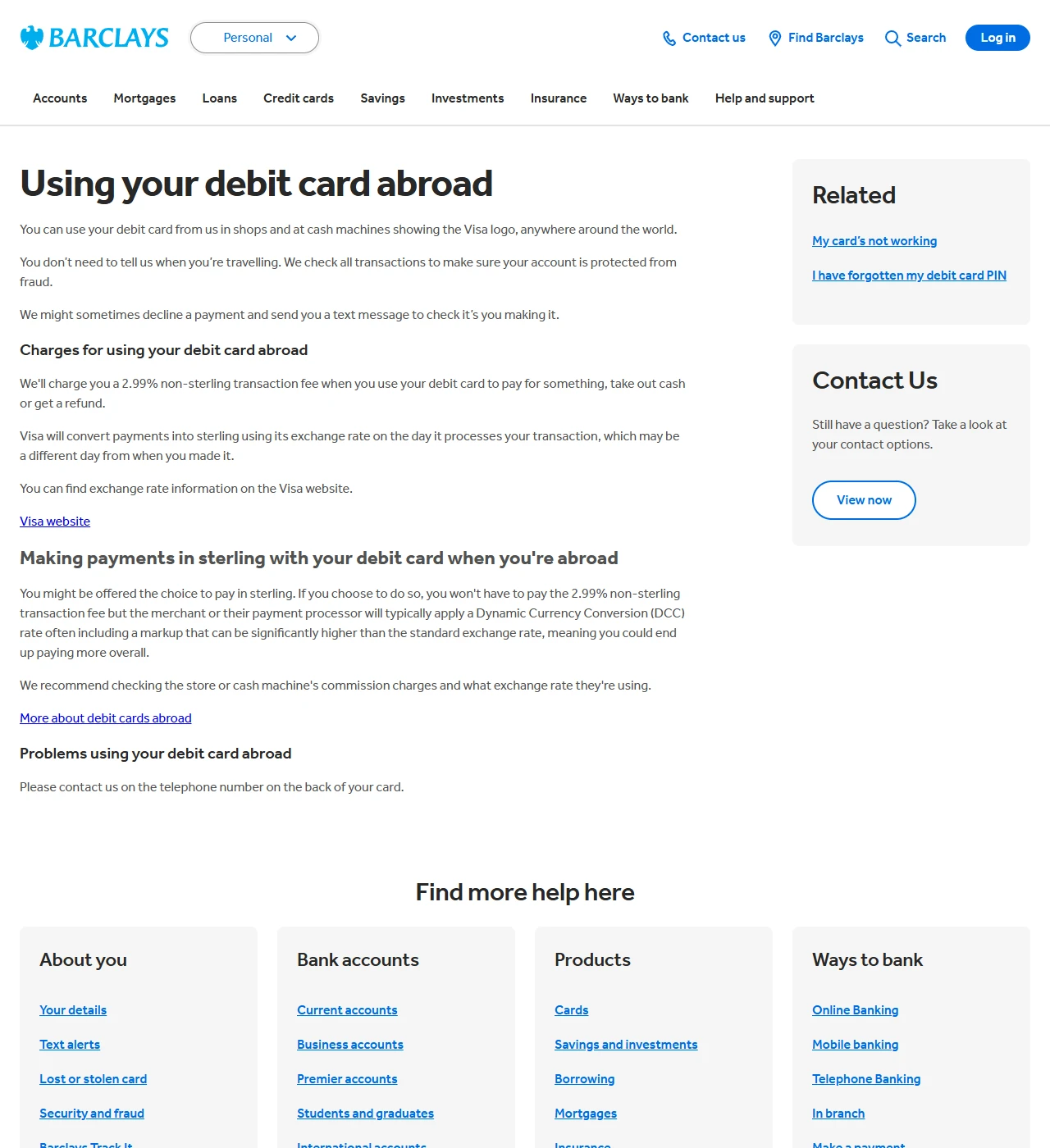
Most unfamiliar foreign charges on a statement are one of five things. The first is your bank's foreign transaction fee: Bank of America says it charges 3% of the converted US dollar amount, and Barclays in the UK calls it a non-sterling transaction fee and charges 2.99%. The second is a card network cross-border fee that some banks list separately; one US credit union shows Visa's 1% international service fee as its own line. The third is a DCC markup when you chose to pay in your home currency abroad, and India's IndusInd Bank adds a 1% fee plus tax on those payments. The fourth is an ATM operator's fee. The fifth is the gap that appears when a refund or a returned deposit is converted at a different rate. The first three are normally in your card agreement or fee schedule and rarely come back. A charge that doesn't match the receipt, the same payment taken twice, or a refund that never arrives is a billing error you can dispute with your card issuer. Below is a table of what each line means, then how to check them, how to dispute, and how to pay less next time.
Contents
01What each of these lines means
| What the line may be called | What it is and how it's worked out | Can you get it back? |
|---|---|---|
| Foreign Transaction Fee or International Transaction Fee (US); Non-Sterling Transaction Fee (UK); Foreign Currency Markup (India) | A percentage your bank takes on the converted amount. Bank of America says 3% of the converted US dollar amount; Barclays charges 2.99% on debit card payments, cash withdrawals and refunds | Usually not, if it's in the fee schedule; if your card says there's no such fee and you were charged, that's a billing error |
| International Service Assessment (ISA), International Service Fee, Cross-Border Fee | A card network fee on cross-border transactions that some banks pass on as a separate line. One Oregon credit union says Visa charges 1% on non-US-dollar purchases and 0.80% on US-dollar purchases outside the US | As above; it can apply even when you pay in US dollars abroad |
| DCC Markup | You chose to pay in your home currency abroad, so the merchant's rate already includes a markup and usually doesn't show as a separate line. Some issuers add their own fee too: since 6 April 2023, IndusInd charges 1% plus tax on rupee payments abroad or to merchants registered overseas | Hard to recover, since you accepted the rate at the till; choose the local currency next time |
| ATM Fee, ATM Operator Fee, Cash Fee | Your bank's cash fee plus whatever the ATM owner charges. Bank of America warns that foreign ATM operators offering to convert for you may charge a higher conversion fee | Stated fees usually stay; an ATM that dispensed less or nothing but still charged you is a billing error |
| Refund, Reversal or Credit that doesn't match | Refunds are converted at the rate on the day they're processed, which may differ from the purchase; Barclays also charges 2.99% on debit card refunds | Rate differences usually stay; a full refund still missing after a billing cycle is worth chasing |
Banks name and price these lines their own way, so yours may look different. If you don't have the fee schedule to hand, search your bank's app or fees page for foreign, international, cross-border, non-sterling or markup, and the matching line usually turns up.
02Checking each line against the receipt: four steps
- Find the receipt or order screenshot. Look at the local currency amount and the currency you paid in. If the receipt shows your home currency and an exchange rate, you were charged via DCC and the markup is already in the amount.
- Check the dates. Statements usually show a transaction date and a posting date. Barclays says Visa uses its rate on the day it processes the payment, which can be later than the day you paid, so a mismatch with the rate you saw that day is normal.
- Do the sum. Multiply the local amount by the market rate around the posting date and compare it with the home-currency amount on the statement; add the fee line underneath and you have the total cost of that payment. The card cost calculator shows the percentage you overpaid.
- See whether the fee is listed separately. Some banks add a fee line under each payment, some fold the fee into the converted amount, and some total it at the end of the statement. If you can't find it any of those ways, check the card's fee schedule.
Treat hotel and car hire deposits separately: a hold that's released, or a charge that's refunded, shows as a plus and a minus line, and the gap usually comes from converting twice; see the deposits and holds guide.
03What you can dispute, and how
You can dispute billing errors: an amount that doesn't match the receipt, the same payment taken twice, a charge you didn't make, a refund or deposit that never came back, cash you didn't get from an ATM, and a fee your card says it doesn't charge.
Usually not recoverable: foreign transaction and cross-border fees in your agreement, a DCC rate you accepted at the till, and exchange rate differences on refunds. If the amount is small and you've banked there a while, you can ask for a one-off goodwill refund, but that's a request the bank can turn down.
- Gather your evidence first: the receipt or order screenshot, any messages with the merchant, and a screenshot of the statement line.
- US credit cards: the CFPB says to send a written billing error notice to the card company within 60 days after the charge appeared on your statement, with your name, account number, the amount and why you think it's wrong; the company has 30 days to confirm it received your dispute.
- Cards from other countries, and debit cards: look for "dispute a transaction" or similar in your bank's app, or call the number on the back of the card. Deadlines vary by bank, so ask customer service for the one on your card and don't wait.
- If you suspect fraud: freeze the card first, then follow the fraud steps in the card declined guide.
04Paying less of this next time
- Before you go, check your main card's fee schedule: only a foreign transaction fee of 0 or None is genuinely free. If in doubt, take a multi-currency card as a backup, and see how foreign transaction fees are made up.
- When a card terminal or ATM asks whether to pay in your home currency or the local one, choose local; here's why.
- Paying in your home currency outside your country doesn't always avoid a cross-border fee; the US credit union above charges 0.80% on US-dollar transactions abroad.
- Take out enough cash in one go rather than lots of small withdrawals, which repeat fixed fees; the ATM guide has the full sums.
05Common questions
What is the international service fee on my bank statement?
Usually a card network fee on cross-border transactions that your bank passes on to you as a separate line. A credit union in Oregon, for example, says Visa charges 1% on non-US-dollar purchases and 0.80% on US-dollar purchases made outside the US, both shown as separate line items. Whether your card charges it, and how much, is in your bank's fee schedule.
Why was I charged a foreign transaction fee when I paid in my own currency?
Many issuers look at where the merchant is, not just the currency. The Oregon credit union above charges 0.80% on US-dollar transactions outside the US, and India's IndusInd Bank charges 1% plus tax on rupee payments made abroad or to merchants registered overseas. Barclays in the UK waives its 2.99% fee if you pay in sterling, but the merchant then converts at a DCC rate that is often worse.
Why is my refund less than what I paid?
A refund is converted again at the rate on the day it is processed, so if the rate has moved, the home-currency amount moves too; some banks also charge their fee on refunds, Barclays charges 2.99% on debit card refunds, for example. A small difference is usually not a mistake; a refund that never arrives is the thing to chase.
Can I get a foreign transaction fee refunded?
If it is in your card agreement or fee schedule, usually not. If your card says it has no foreign transaction fee and you were charged one anyway, or the fee was worked out on the wrong amount, that is a billing error you can dispute with your card issuer.
How long do I have to dispute a wrong charge?
For US credit cards, the Consumer Financial Protection Bureau says to send a written notice to the card company within 60 days after the charge appeared on your statement. For cards from other countries and for debit cards, deadlines vary, so raise it in your bank's app or with customer service as soon as you notice, and keep the receipt and screenshots.
06Read next
Update note: First published 2026-10-29. Bank of America's 3% international transaction fee and its warning about foreign ATM conversion come from its international ATM page; Visa's 1% international service fee, the 0.80% fee on US-dollar transactions abroad and how they're listed come from Oregonians Credit Union's FAQ; Barclays' 2.99% non-sterling transaction fee, its application to refunds, Visa's processing-day rate and the note on paying in sterling come from Barclays' help page; IndusInd's 1% DCC markup comes from the bank's DCC FAQ; the 60-day written notice and 30-day acknowledgement come from the CFPB. All were read on 2026-10-29.
Sources: Bank of America: international ATMs and transaction fee · Oregonians Credit Union: Visa foreign transaction fees · Barclays: using your debit card abroad · IndusInd Bank: DCC markup FAQ · CFPB: how to dispute a charge on your credit card bill.